Yiping Goh on BRAVE: Returning to Founding and Building FORMAS.AI
Yiping Goh joins BRAVE’s Jeremy Au to share why she returned to founding, what it means to build FORMAS.AI with Carlos Bañón, and why rendering is only one part of the design process.

Nine years after her last startup chapter, Yiping Goh faced a familiar question: was it time to build again?
In the years between, she had invested in founders, joined McKinsey as a partner, and taken on an executive role at global immersive entertainment company NEON. Each experience gave her a different perspective on how businesses grow.
Returning to founding meant bringing those lessons into a new company. It also meant making a family decision with her husband, architect and FORMAS.AI co-founder Carlos Bañón.
In her conversation with Jeremy Au on the BRAVE podcast, Yiping reflects on that choice, the realities of building together, and the design problems that drew them to FORMAS.AI.
A different perspective on building
Yiping’s move into consulting came from a desire to learn how larger organisations think and operate.
At McKinsey, she found an environment that challenged her to sharpen her thinking, communicate clearly and work at an institutional scale. Through venture building, she continued helping turn ideas into businesses.
Her next chapter at NEON brought those lessons into a growing global company. The work involved introducing systems and processes that could support expansion, alongside the harder task of helping people adopt new ways of working.
By the time she considered founding again, she had experienced business from several positions: entrepreneur, investor, adviser and operator. Those years shaped the founder she would become at FORMAS.AI.
The question behind FORMAS.AI
Meanwhile, Carlos was exploring how AI could support architecture and design.
Yiping recalls seeing the technical workflows he was assembling and asking whether he was coding or designing. He explained that he was coding so that he could design.
The exchange pointed to a problem they kept returning to. Designers wanted to spend their time developing ideas, but using emerging AI capabilities could require considerable technical setup.
Carlos’s teaching revealed another challenge. Workshop participants could experience those workflows during a session, yet continuing to use them independently afterwards was more difficult.
That raised a question: how could they make these capabilities accessible in a workspace that architects and designers could use in their everyday practice?
A decision made as a family
The move into FORMAS.AI followed a year of discussion.
Yiping had built a career outside startups. She and Carlos also had two young children, established responsibilities and a life that would change if they committed to building the company together.
They weighed those considerations alongside the response to FORMAS.AI’s public beta. People began subscribing, asking questions and reaching out to the founders. Those interactions helped them understand both the demand and the work ahead.
The signals did not make success certain. They gave the couple enough confidence to take the next step.
For Yiping, returning to founding meant accepting uncertainty with a broader set of experiences behind her and a clearer understanding of the commitment involved.
Why rendering is only part of the puzzle
One of the episode’s central themes is the gap between producing an image and developing a design.
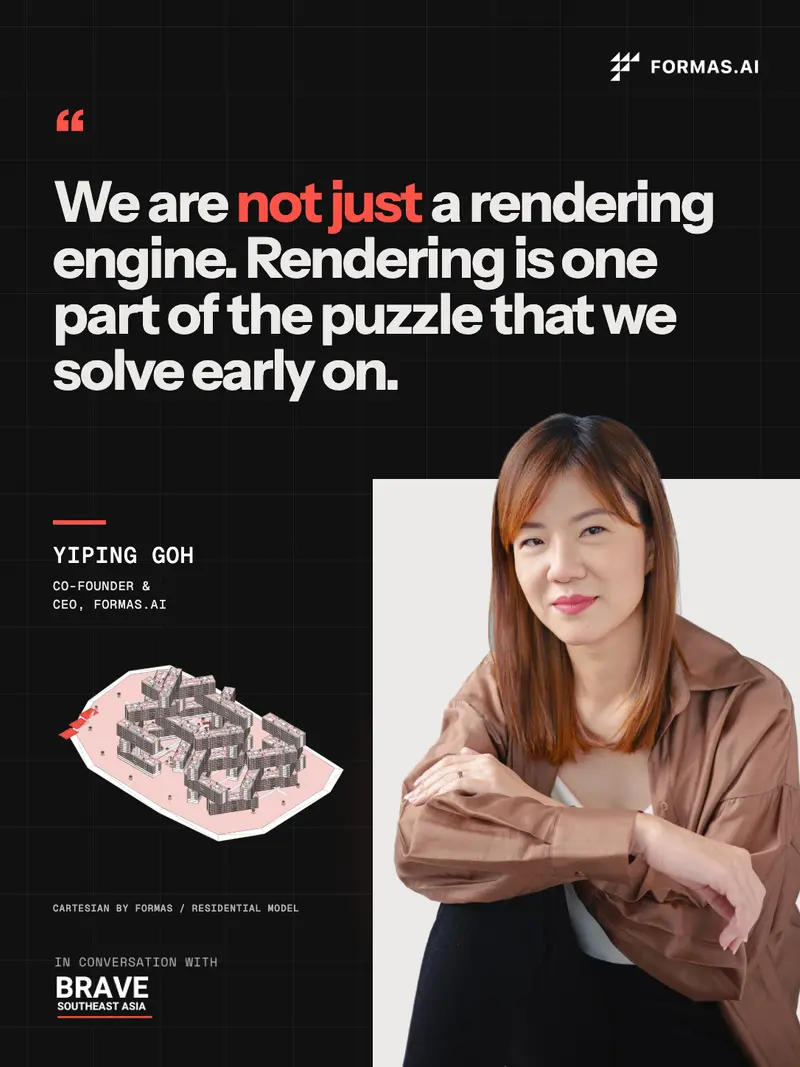
“We are not just a rendering engine. Rendering is one part of the puzzle that we solve early on.”
Yiping describes how much work can happen before a client has agreed on a direction. A designer takes an idea into modelling and visualisation, moving between tools to produce something the client can understand.
Then the feedback arrives. A material changes. Another angle is needed. The layout needs revising.
The image has helped move the conversation forward, but the design process continues. Each revision needs to preserve the decisions and intent that came before it.
FORMAS.AI brings sketches, references and spatial intent into an AI-native design workspace. The broader ambition is to support a more connected process through exploration, revisions and design development, helping designers build on their ideas while retaining control.
In the interview, Yiping also discusses carrying information into later project stages as a continuing development direction. Rendering is an important early part of that larger vision.
Making an idea easier to discuss
The conversation also returns to a practical purpose of design tools: helping people understand one another.
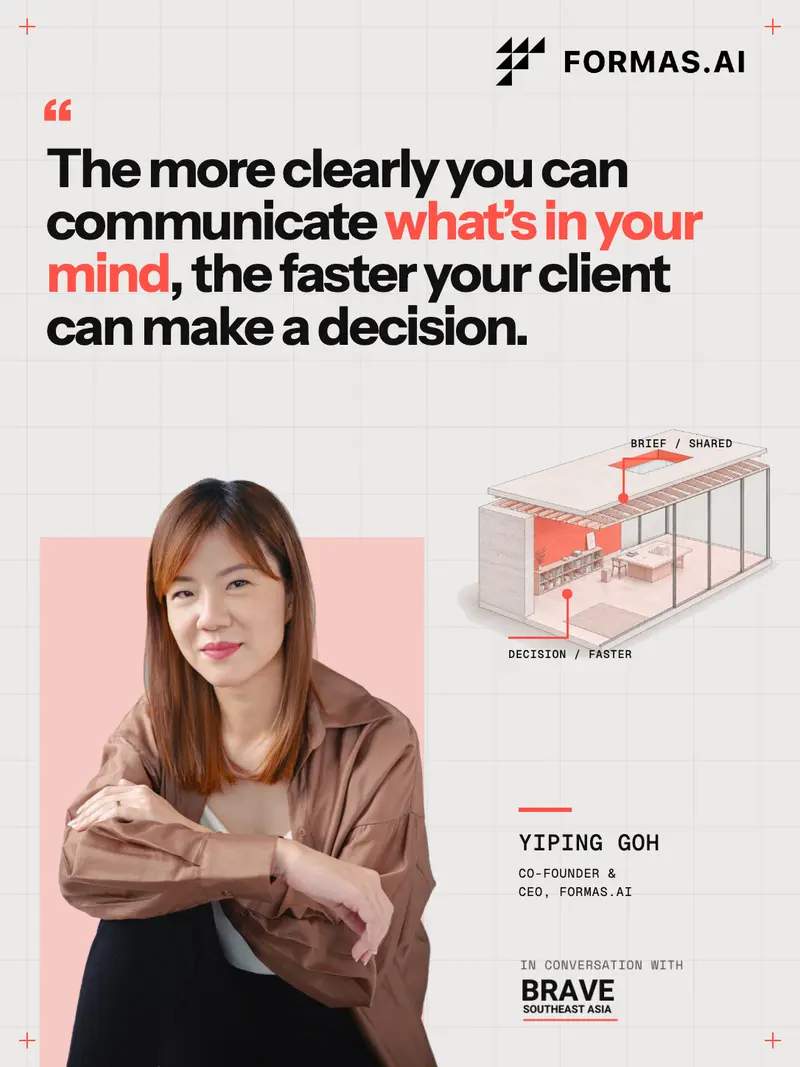
“The more you can communicate what is in your mind the faster you get to a decision.”
A drawing or model may be clear to an architect while leaving a client unsure about the space it represents. Making the idea visible gives both people something concrete to discuss.
They can compare materials, consider another view or explain why a particular option feels right. Those conversations help the designer understand the client’s priorities and decide what to develop next.
For FORMAS.AI, this connects visual exploration to the wider design process. The designer’s judgement remains central, with the workspace helping them express and develop their intent.
Building together and choosing when to begin
FORMAS.AI was not Yiping and Carlos’s first experience of working together. During the pandemic, they started Casa Julia, a side business inspired by their love of Spanish food.
That project gave them an early understanding of their working relationship. In the podcast, Yiping describes a shared attention to detail, strong ownership of their work and a willingness to put sustained effort into something they care about.
Those qualities now inform their partnership at FORMAS.AI, alongside the practical demands of raising a family and building a company.
Yiping’s account of starting again combines courage with preparation. She talks about recognising signals, considering the risks and deciding when an opportunity is worth pursuing.
AI presented a chance to help shape change in a field Carlos knew deeply. FORMAS.AI became their way of taking part.
Watch or listen to the full conversation
The full episode explores Yiping’s career transitions, lessons from building at different scales, and the personal decisions behind returning to startup life.
Thank you to Jeremy Au, Edric Poon, Fitri and the BRAVE team for the thoughtful conversation and for sharing Yiping’s journey and the story behind FORMAS.AI.


